- Added 1/4 tsp LH100 (Choozit brand) and 1/4 tsp of Thermo C (Abasia brand) culture to 3 gallons of whole milk at 95 degrees F. Hold at temp for 30 minutes.
- Added 1.5 tsp of veal rennet diluted in 1/4 c water to the cheese milk and held at temperature for 45 minutes.
- When the curd is set, scoop into moulds and wait for the whey to drain out. Not all the curd will fit into the moulds immediately. I filled them and waited 15 minutes for them to drain and kept scooping more in on top.
- After draining for 15 minutes, the curd drops about an inch. I give it a stir with the knife, pulling it away from the sides of the baskets so that more whey can escape through the unplugged holes.
- After about 2 hours of draining and adding more curd, all the curd is finally in the baskets.
- As soon as the last of the curd is added to the baskets, the baskets are flipped onto a reed mat to drain for another 2 hours.
Showing posts with label cheese. Show all posts
Showing posts with label cheese. Show all posts
Saturday, February 11, 2012
Columella's Cheese - Redaction II


Saturday, November 5, 2011
Markham's Cheese In Practice:
Everything starts out "normal" with this cheese... Which is to say that we have to do a couple of steps to bring pasteurized milk back to a state similar to the one that Markham's milk maids would have gotten from milking a cow and taking milk directly to the dairy.
- Heat the milk to about 90 degrees F. (Cow temperature less a few degrees that the dairy maids would have lost in transport anyway.
- Infect the milk with some cultured buttermilk. (mesophilic lactobacillus) These would have been native to the cow's teats and since the period milk wouldn't have been pasteurized, the bacteria wouldn't have needed to have been re-added. (Wait 60 minutes for the bacteria to get going in the new environment.)
- Here's where we start picking up the period steps. We add our rennet. I did not use Markham's rennet recipe, because I think it's nasty. I used double strength vegetable rennet. Not period, but chemically very similar to calf rennet, which I have also used. Very little difference in final product.
Hand stirred curd. - After 45 minutes, I cut the curd. After cutting it, I gave it 15 minutes to heal, and then I gave it a stir with my bare, washed hand.
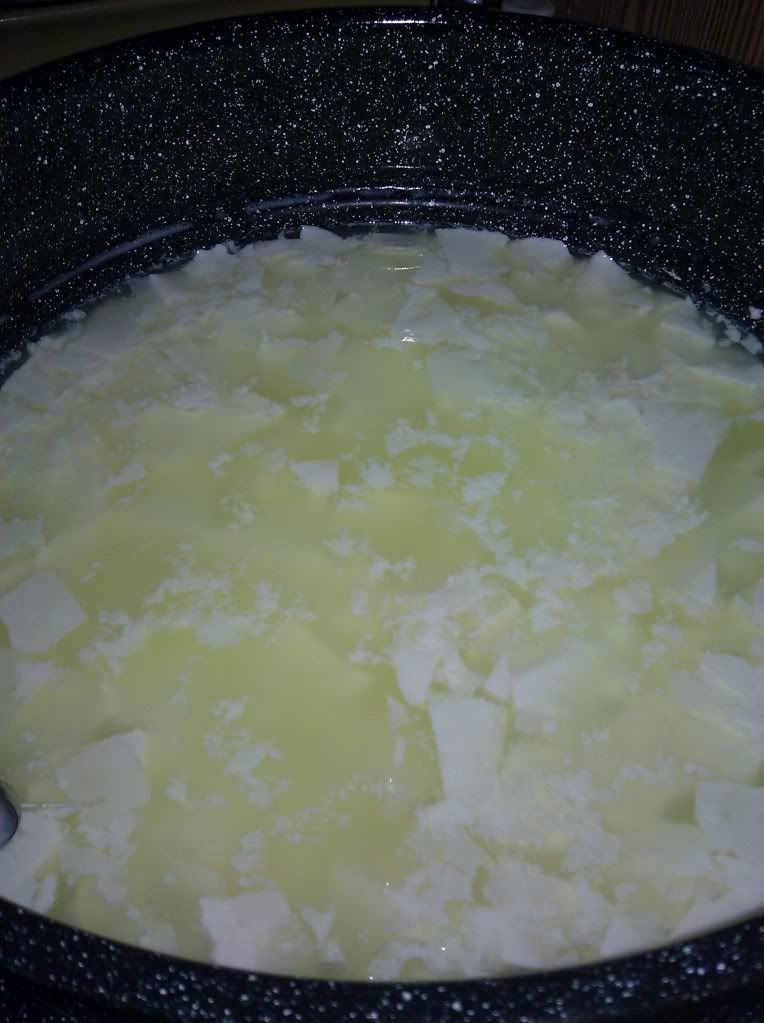
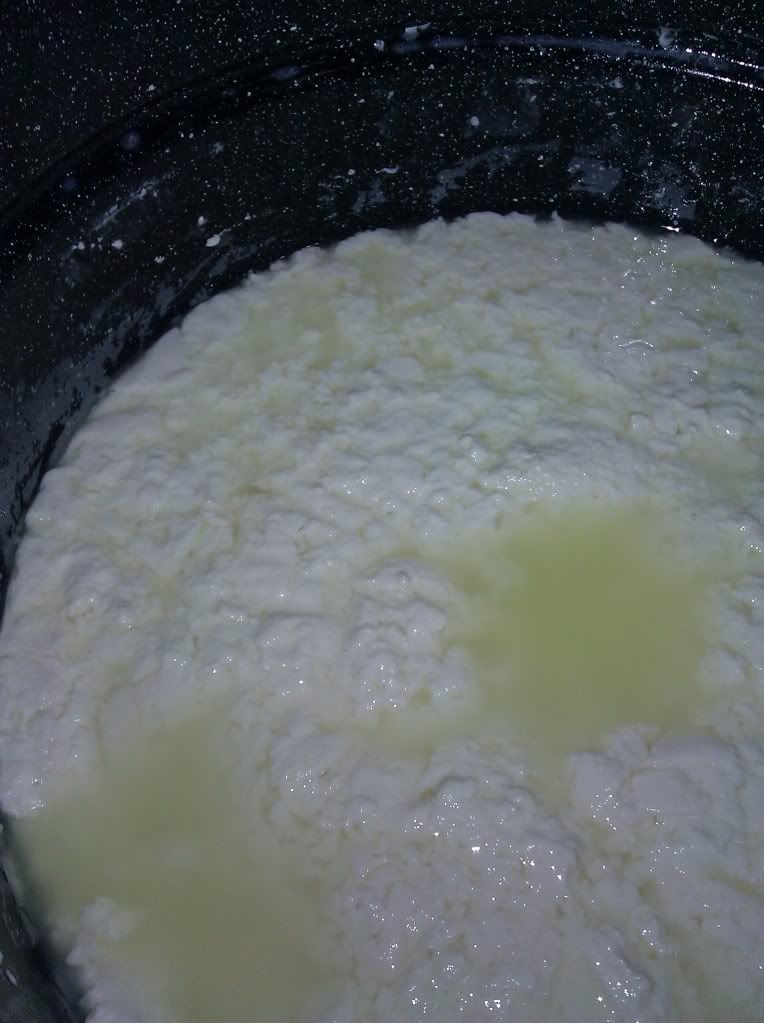
- Then my instructions said to let the curd settle and press it to the bottom of the pot with my hands, and then scoop off as much whey as possible with a shallow dish. This seemed horrendously inefficient (typical non-cooking-person cooking instructions), so I placed a piece of sterilized cheese cloth on top of the curd, and scooped out the whey that seeped through the cloth. It's MUCH easier to do this way without losing curd. The picture shows what my curd looked like after I'd scooped off about a gallon of whey - which I set aside for a dessert experiment... (Chocolate brunost, per Deja's request.)
Curd mass after light pressing
by hand - The next step involved carefully scooping the curd mat into the "mold" and pressing it under a light weight. I scooped the curd mat into a piece of cloth on a screen strainer, because I didn't have a basket to scoop my curd into as the initial mold. I folded the cloth over the top of the curd and pressed it gently but firmly with my hands. After about 30 minutes of fussing, the curd was much more firm and ready for the press.
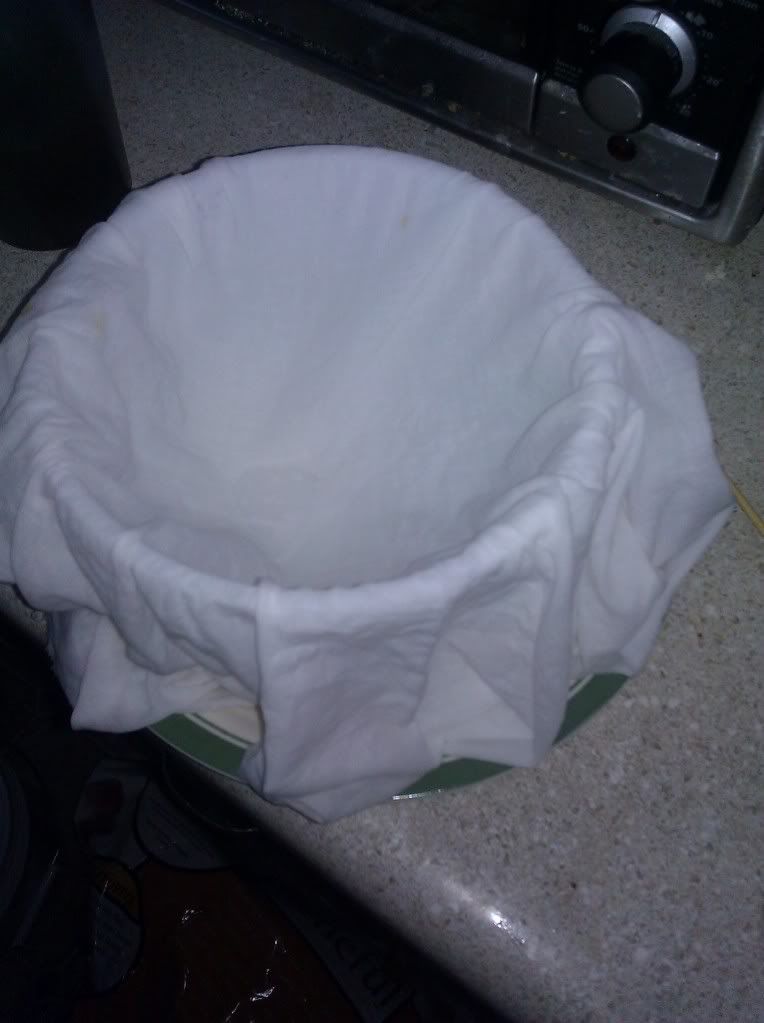
Mould lined with damp
clothMould with curd in the
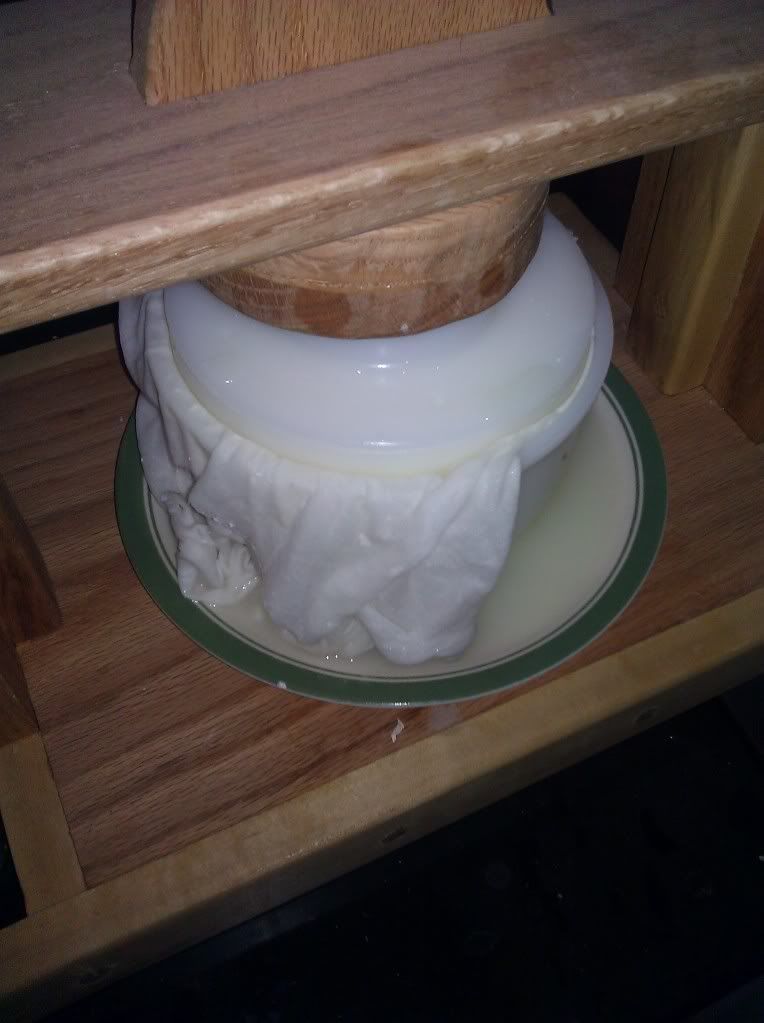
press - Then my directions say to turn out the curd into a clean cloth that has been dampened with cool water and press it in my big press. Here are the mould dressed with a wet cloth, and the curd in the great press:
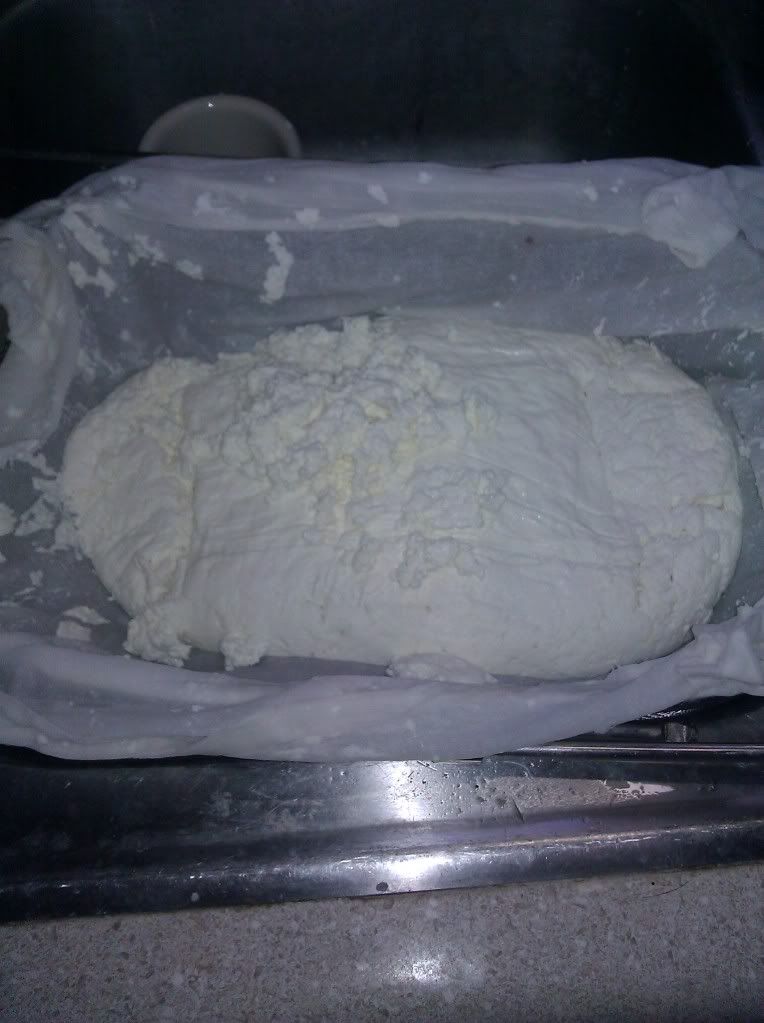
Curd flipped into a new
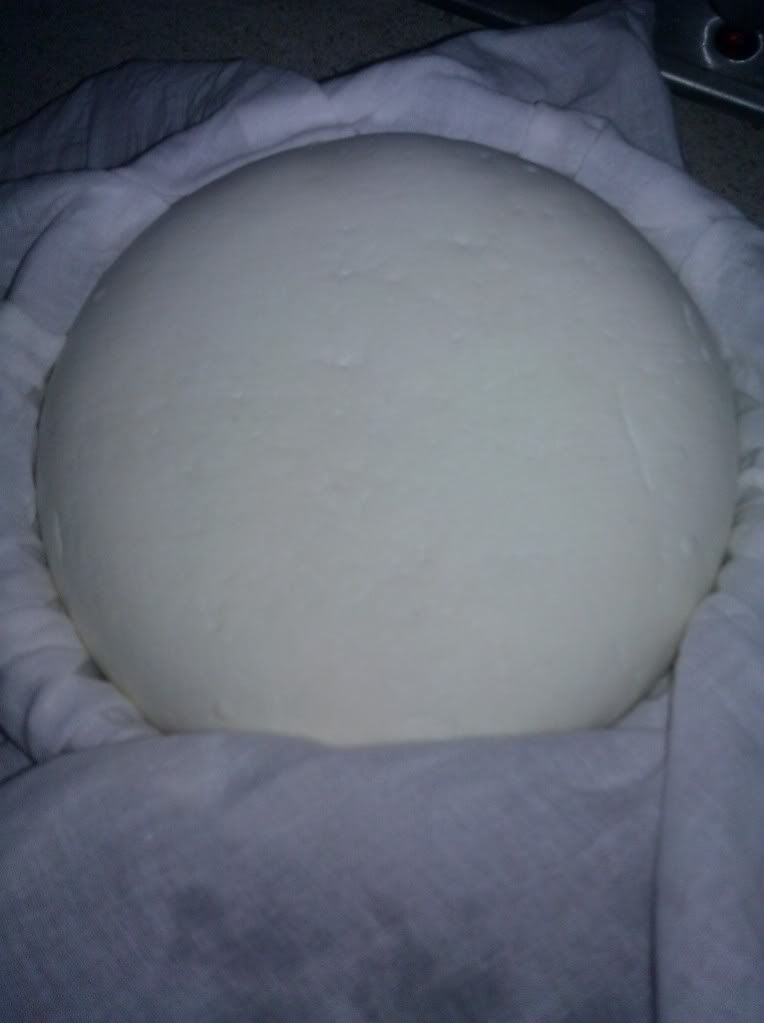
dry cloth. - Following these steps, I am meant to wait for 30 minutes, and then turn out the curd into a dry cloth and return it to the press. This cloth should be exchanged 5-6 times for a new clean, dry cloth in the next 24 hours, each time the cheese is flipped and returned to the press.
- Tomorrow, I shall return the cheese to the press in the mold with no cloth and leave it there for about twelve hours.
- After I remove the cheese from the final pressing, I need to rub it in salt and start the curing process...
Tuesday, November 1, 2011
Columella and Markham Cheese Process in My Own Modern Shorthand:
Columella Process
•After curd formation transfer curd into baskets to remove whey. (Similar to brie/camembert draining process.) Once sufficient whey has been extracted to make the curd more solid, press under weight.
•Remove from molds and rub with salt. Let rest overnight.
•Press under more weight.
•Rub with more salt.
•Press under more weight.
•After 9 days, rinse thoroughly with warm water.
•Age.
Markham Process
•After curd formation stir “well” and “diversely.”
•Press curd to the bottom of the pan and remove as much whey as possible from the top. (Similar to Gouda curd mat formation.)
•Press curd into the mold, breaking up the curd mat with hands as you go. Press under a small amount of weight for a couple hours.
•Turn out curd onto a wet cloth and press under a greater weight for a half hour.
•Flip cheese into a dry cloth and press under a greater weight for 24 hours, changing the cloth 5-6 times for a new dry cloth.
•Press for 24 hours.
•Press for 12 hours with no cloth
•Rub with salt. And let it rest for 24 hours.
•Wipe down with a clean cloth, rub with salt, flip and let it rest for 24 hours.
•Rub down daily with a clean cloth and keep an eye on it to make sure it doesn’t dry out too fast.
•After curd formation transfer curd into baskets to remove whey. (Similar to brie/camembert draining process.) Once sufficient whey has been extracted to make the curd more solid, press under weight.
•Remove from molds and rub with salt. Let rest overnight.
•Press under more weight.
•Rub with more salt.
•Press under more weight.
•After 9 days, rinse thoroughly with warm water.
•Age.
Markham Process
•After curd formation stir “well” and “diversely.”
•Press curd to the bottom of the pan and remove as much whey as possible from the top. (Similar to Gouda curd mat formation.)
•Press curd into the mold, breaking up the curd mat with hands as you go. Press under a small amount of weight for a couple hours.
•Turn out curd onto a wet cloth and press under a greater weight for a half hour.
•Flip cheese into a dry cloth and press under a greater weight for 24 hours, changing the cloth 5-6 times for a new dry cloth.
•Press for 24 hours.
•Press for 12 hours with no cloth
•Rub with salt. And let it rest for 24 hours.
•Wipe down with a clean cloth, rub with salt, flip and let it rest for 24 hours.
•Rub down daily with a clean cloth and keep an eye on it to make sure it doesn’t dry out too fast.
Monday, October 31, 2011
Plan, based on period cheese making techniques, and Lancashire legend:
So here's my initial plan for a peri-oid cheddar. According to legend, Lancashire cheese was produced in small batches of curd over a period of days. Early on, they were just using "left over" milk to produce cheese, so they didn't have enough curd each day to produce a single cheese. So the left over milk each night was turned into curd, and then after 2-3 days, the accumulated curd was combined into a single cheese and pressed. Based on my reading of the two previously displayed sources, this will work out for me because they didn't seem to be heating the curd after the cutting phase, thus a lot of whey would be left in the curd. Because they're also not salting the curd, the whey will have even more reason to stay in the curd. Thus, leaving the curd to drain over night in a basket will give me the dryer curd that I want, while not utilizing any "new" techniques. Additionally, from my reading, it looks like the curd pressing in both descriptions took DAYS. So my curd accumulation process shouldn't deviate in an unheard of way from the known-to-me "traditional" methods. The one "uneasy" spot for me here is that I haven't seen anything about milling curd in period literature.
I think this will be something that I will try out during the work week, and then on the weekend, I'll try doing a straight up 3 lb batch where all the curd is pressed as a single group, rather than staggered.
So here's my initial plan for a peri-oid cheddar. According to legend, Lancashire cheese was produced in small batches of curd over a period of days. Early on, they were just using "left over" milk to produce cheese, so they didn't have enough curd each day to produce a single cheese. So the left over milk each night was turned into curd, and then after 2-3 days, the accumulated curd was combined into a single cheese and pressed. Based on my reading of the two previously displayed sources, this will work out for me because they didn't seem to be heating the curd after the cutting phase, thus a lot of whey would be left in the curd. Because they're also not salting the curd, the whey will have even more reason to stay in the curd. Thus, leaving the curd to drain over night in a basket will give me the dryer curd that I want, while not utilizing any "new" techniques. Additionally, from my reading, it looks like the curd pressing in both descriptions took DAYS. So my curd accumulation process shouldn't deviate in an unheard of way from the known-to-me "traditional" methods. The one "uneasy" spot for me here is that I haven't seen anything about milling curd in period literature.
I think this will be something that I will try out during the work week, and then on the weekend, I'll try doing a straight up 3 lb batch where all the curd is pressed as a single group, rather than staggered.
Subscribe to:
Posts (Atom)