Thursday, November 3, 2011

Period Apples:

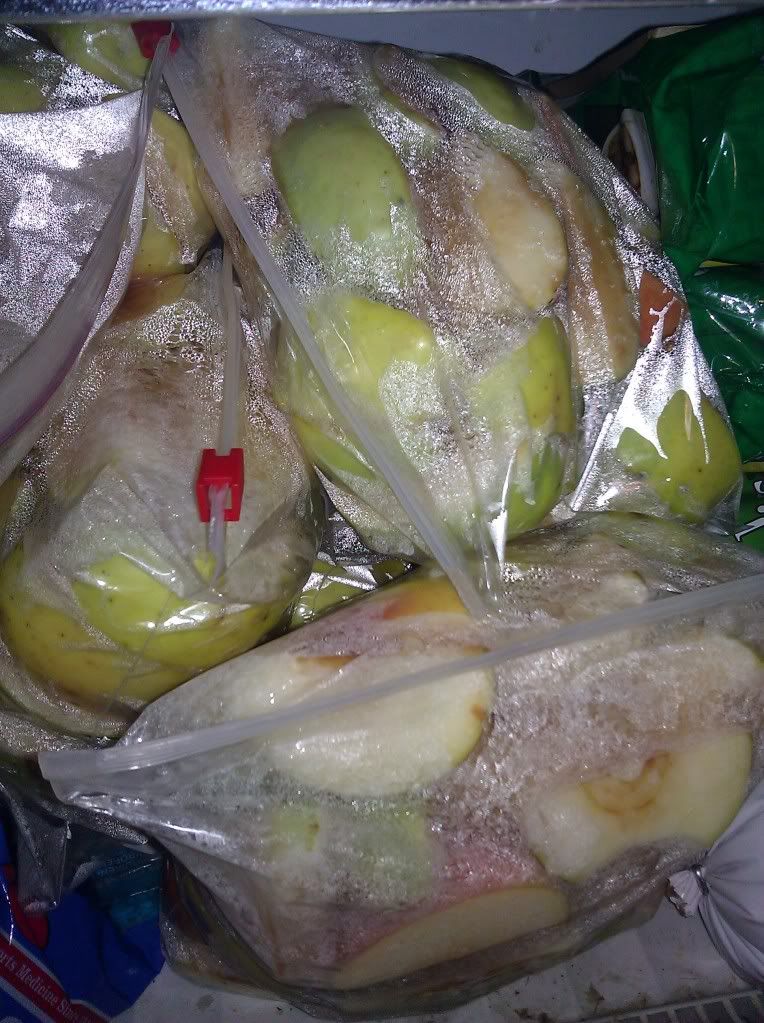
Rosemarion sent me some period apples from an orchard near her that specializes in them! Last night, I finally got 'round to coring and deworming them so that they can eventually be pressed into cider and made alcoholic.

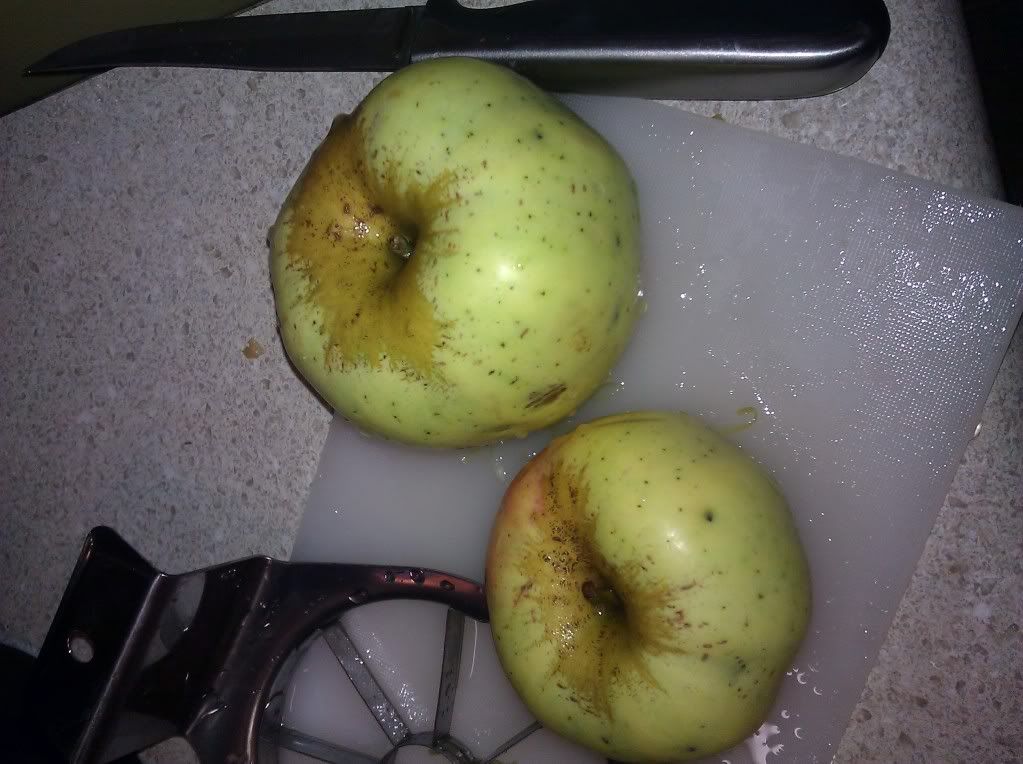
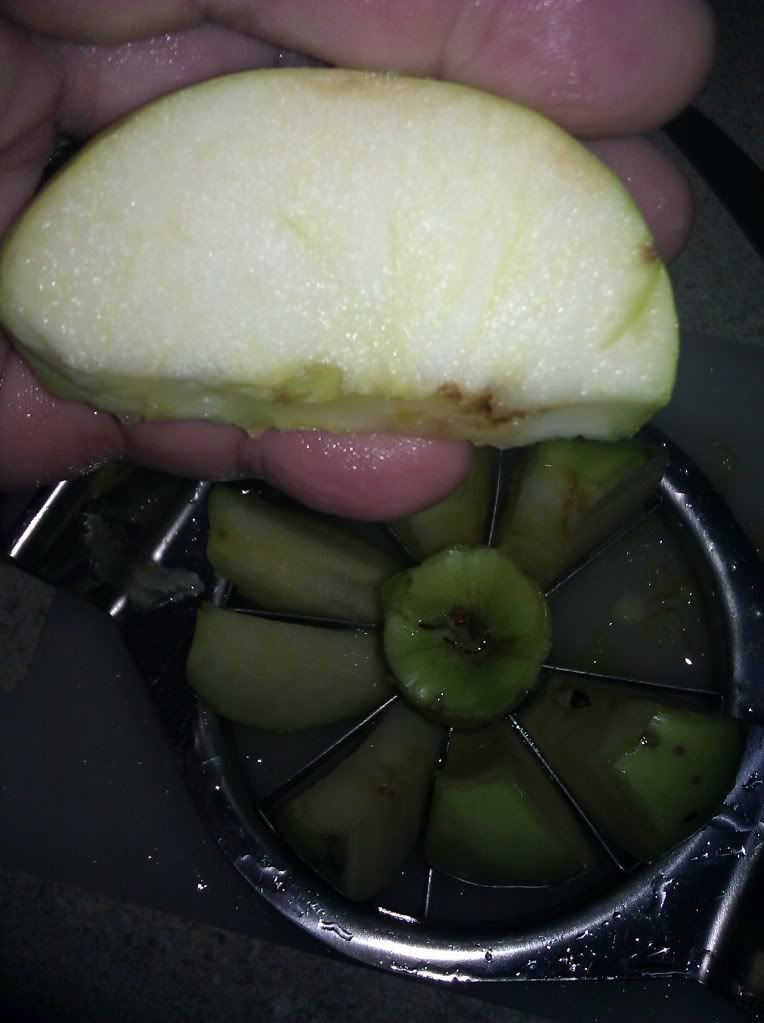
The flavor of these apples was similar to that of a MacIntosh or crab apple, but less tart than the MacIntosh and sweeter than crab apple. The meat of the apples was a bit peculiar in that it looked in many places as though the core wasn't sure it wanted to be contained to the center of the fruit.

I took a picture, but sadly, the specks of oddness don't appear to be showing up very well. I ended up getting about 4, 1 quart ziplock bags and a bit extra cored and stuffed in the freezer. Freezing the fruit will break down the cell walls and allow me to extract more juice once pressing time comes. Miss Chelsea and I are investing in an antique fruit press/sausage stuffer, which I should be able to use to press the juice out of these apples once my primary fermenter is empty again.


The description on these lovelies per the orchard is as follows:
Calville Blanc d'Hiver (1598) Antique variety from France, where it was grown in the king's gardens at Orleans; one of the premier gourmet apples, still served for dessert in the finer Parisian restaurants; tart, strong, distinctive flavor

Wednesday, November 2, 2011

I know! Let's make a tent!

As you know, I never have enough to do in my copious spare time as a new mother. Thus, I'll be making myself a new bedouin style tent for local camping. The reasons (And following that, design specs...) I am setting aside my pavilion are as follows:
  1. It doesn't fit in my car very well with it's 18, 6 foot long poles, weirdly shaped ridge pole, and square center pole.
  2. I can't put it up by myself.
So, I needed a tent that would do well in prairie camping conditions that wouldn't necessarily require the head space that Zig needs when he camps (because if he's coming, I'll have a bigger vehicle for the tent, AND someone to help me set up.) or the minimal footprint required from a tent used at Pennsic. Pennsic is the ONLY camping event I attend that has that kind of square footage restriction. I wanted something period, and something that would be relatively easy to make without a lot of tent making experience.

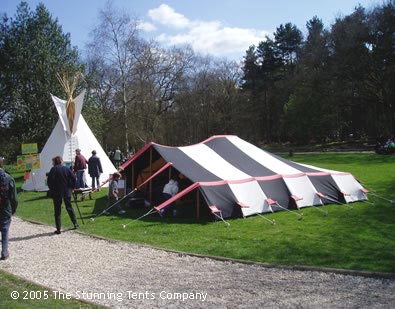
That's how I settled on the ouled nail (ooled nayal) bedouin tent design that Elizabeth and Krystal used for their tents. The tent will essentially be a giant rectangular tarp with one 4' long ridge pole supported by two 7' long two by two's and 16, 4' long wall poles. There will also be about 6 front and back door poles of various lengths from about 7' to 4', but I'll figure out those lengths when I "get there."


Above is an example of an ouled nail style tent. I intend to have similar striping in my canvas, only my stripes will be alternating white and pumpkin colored, and the pumpkin color will also be used for the tension bands (triga) that you see on the example tent in red.

Last night I cut my pumpkin colored sunforger. (I think they refer to this color as "khaki," but srsly... it's pumpkin.) I have the following pieces:
  • 3, 28"x330" tent panels.
  • 1, 12"x268" central triga band
  • 2, 8"x268" wall triga bands
  • 4, 12"x36" false triga bands
  • 12, 8"x15" stake bands (every wall seam)
  • 4, 4"x15" stake bands (outer edge)
I've held off on cutting the stake bands to length until the artwork that I've commissioned for this tent is delivered. Once I have it, I'll be able to figure out how long I really want my stake bands to be to fasten it to the tent securely, center the art, and have enough band left to attach the dowel at the bottom of the stake band. 

Tuesday, November 1, 2011

Columella and Markham Cheese Process in My Own Modern Shorthand:

Columella Process
•After curd formation transfer curd into baskets to remove whey. (Similar to brie/camembert draining process.) Once sufficient whey has been extracted to make the curd more solid, press under weight.
•Remove from molds and rub with salt. Let rest overnight.
•Press under more weight.
•Rub with more salt.
•Press under more weight.
•After 9 days, rinse thoroughly with warm water.
•Age.

Markham Process
•After curd formation stir “well” and “diversely.”
•Press curd to the bottom of the pan and remove as much whey as possible from the top. (Similar to Gouda curd mat formation.)
•Press curd into the mold, breaking up the curd mat with hands as you go. Press under a small amount of weight for a couple hours.
•Turn out curd onto a wet cloth and press under a greater weight for a half hour.
•Flip cheese into a dry cloth and press under a greater weight for 24 hours, changing the cloth 5-6 times for a new dry cloth.
•Press for 24 hours.
•Press for 12 hours with no cloth
•Rub with salt. And let it rest for 24 hours.
•Wipe down with a clean cloth, rub with salt, flip and let it rest for 24 hours.
•Rub down daily with a clean cloth and keep an eye on it to make sure it doesn’t dry out too fast.

Monday, October 31, 2011

Plan, based on period cheese making techniques, and Lancashire legend:

So here's my initial plan for a peri-oid cheddar. According to legend, Lancashire cheese was produced in small batches of curd over a period of days. Early on, they were just using "left over" milk to produce cheese, so they didn't have enough curd each day to produce a single cheese. So the left over milk each night was turned into curd, and then after 2-3 days, the accumulated curd was combined into a single cheese and pressed. Based on my reading of the two previously displayed sources, this will work out for me because they didn't seem to be heating the curd after the cutting phase, thus a lot of whey would be left in the curd. Because they're also not salting the curd, the whey will have even more reason to stay in the curd. Thus, leaving the curd to drain over night in a basket will give me the dryer curd that I want, while not utilizing any "new" techniques. Additionally, from my reading, it looks like the curd pressing in both descriptions took DAYS. So my curd accumulation process shouldn't deviate in an unheard of way from the known-to-me "traditional" methods. The one "uneasy" spot for me here is that I haven't seen anything about milling curd in period literature.

I think this will be something that I will try out during the work week, and then on the weekend, I'll try doing a straight up 3 lb batch where all the curd is pressed as a single group, rather than staggered.

Sunday, October 30, 2011

The way of salting and pressing cheese:

Below, I have included the text of two different descriptions of hard cheese making. The first is from the first century AD, by a Roman author (Columella) and the second is from the sixteenth century in England (Markham). Very little has changed. With modern cheese making, we add the salt directly to the curds before pressing. Pressing cheese is usually less than a 24 hour affair and then the cheese is off to age. In both of the descriptions from period (and before) you can see that the salt is added during the pressing process, and it is applied to the outside of the cheese as a rub. The added technology in the later description, is the use of cloths to wrap the cheese within the press. (The cheese cloth wicks whey away from the surface of the cheese thus drying it out faster.) Torquatto Tasso, also writing on cheese in the sixteenth century maintained that the cheese must be turned into a new, clean cloth at least 3-4 times in the first day. And if you do not use fine clean linen cloth the cheese will be as a child that has been sitting in a wet diaper too long. How's that for appetizing imagery?

But the milk-tub, when it is filled with milk, ought not to be
without fome gentle warmth. Nevertheless, it muft not be brought
fo near as to touch the flames, as fome people are of opinion, but be
placed not far from the fire, and prefently after it is curdled, the liquor
muft be transferred into wicker-bafkets, cheefe-vats, or moulds; for
h is of great importance, that the whey be ftrained and feparated from
the condenfed fubftance as foon as poflible: for which reafon, the
country-people do not indeed fuffer the moifture to drop flowly from
it of its own accord; but, when the cheefe becomes a little more folid,
they put weights upon it, that thereby the whey may be fqueezed out r
then, as it is taken out of the moulds or frails, it is laid up in a dark
and cold place, upon the very cleaneft boards, that it may/ not be
fpoiled; and it is fprinkled with bruifed fait, that it may fweat out
the acid liquor: and when it is hardened, it is prefled more vehe-
mently, that it may be confpiflated; and it is fpiinkled again with
toafted fait, and condenfed again with weights. After this has been
done for nine days, it is warned throughly with fweet water, and
placed in fuch a manner under a {hade, upon hurdles made for that
purpofe, that one eheefe may not touch another, and that i.t may be
moderately dried. Then, that it may keep the tenderer, they put it
clofe together in feveral ftories, in a clofe place, not expofed to the
winds. Thus it neither becomes fpongy and full of holes, nor fait,
nor dry t the firft of which faults ufes to happen, if it be prefled but a,
little i the fecond, if it be feafoned with too much fait; and the third,
if it be fcorched in the fun. This kind of eheefe may be exported alfo
beyond fea. For that which is defigned to be eaten in a few days,
while it is new, is made up with lefs care : for, being taken out of the
wicker bafkets, it is put into fait and brine, and foon afterwards dried
a little in the fun.
De Re Rustica (Columella)

To make a new milke or morning milk cheese, which is the best Cheese made ordinarily in our kingdome; you shall take your milk early in the morning as it comes from the Cow, and file it into a cleane tubbe, then take all the creame also from the milke you milk the euening before, and straine it into your new milke; then take a pretty quantity of cleane water, and hauing made it scalding hot, powre it into the milke also to scauld the creame and it together, then let it stand, and coole it with a dish rill it be-no more then luke warme; then go to the pot where your 187 earning bagges hangs, and draw from thence so much of the earning without stirring of the bagge, as will serue for your proportion of milke, and straine it therein very carefully; for if the least mote of the curd of the earning fall into the cheese, it will make the Cheese rot and mould; when your earnings is put in you shall couer the mike, and so let it stand halfe an howre or thereabouts; for if the earning be good it will come in that space; but if you see it doth not, then you shall put in more: being come, you shall with a dish in your hand breake and mash the curd together, possing and turning it about diuersly: which done, with the flat palms of your hands very gently presse the curd downe into the bottome of the tub, then with a thinne dish take the whey from it as cleane as you can, and so hauing prepared your Cheese-fat answerable to the proportion of your curd, with both your hands ioined together, put your curd therein and breake it and presse it downe hard into the fat till you hane fild it; then lay vpon the top of the curd your flat cheese-boord, and a little small weight thereupon, that the whey may drop from it into the vnder vessell; when it hath done dropping take a large cheese-cloth, and hauing wet it in the cold water lay it on the cheese-boord, and then turne the cheese vpon it; then lay the cloth into the cheese fat; and so put the cheese therein againe, and with a thin slice thrust the same down close on euery side; then laying the cloth also ouer the top to lay on the cheese-boord, and so carry it to your great presse, and there presse it vnder a sufficient waight; after it hath been there prest halfe an howre, you shall take it and turne it into a drie cloth, and put it into the presse againe, and thus you shall turne it into drie cloathes at least fiue or sixe times in the first day, and euer put it vnder the presse againe, not taking it therefrom till the next day in 178 the euening at soonest, and the last time, it is turned you shall turne it into the dry fat without any cloth at all.

When it is prest sufficiently and taken from the fat, you shall then lay it in a kimnell, and rub it first on the one side and then on the other with salt, and so let it lie all that night, then the next morning, you shall doe the like again and so turne it vpon the brine, which comes from the salt two or three dayes or more, according to the bignesse of the cheese, and then lay it vpon a faire table or shelfe to drie, forgetting not euery day once to rubbe it all ouer with a cleane cloth, and then to turne it till such time that it be throughly drie and fit to goe into the presse; and in this manner of drying you must obserue to lay it first where it may drie hastily, and after where it may drie at more leasure; thus may you make the best and most principall cheese.
The English Huswife (Markham, Gervase)

Sunday, May 29, 2011

Dear Doggie: PLEASE TO NOT FEED TEH BEBE TOADS. KTHKSBAI.

It has been raining all day. My dogs do not like rain – and yet… They still must potty. I have been a mean, mean Momma and made them all go outside twice today, but *certain dogs* have been reluctant to poop … Apparently, getting rained on is so distracting that the poopy process is interrupted and impossible to perform.

Those same certain dogs that do not want to poop outside in the rain, are sometimes sneaky. They creep into my basement to poop in the laundry room when it is raining outside. So it is vital that I leave the basement door CLOSED when it is raining outside. Just in case.

Today, I forgot to close the basement door after coming up with a load of clean diapers. Maggie dashed into the basement while my hands were full and I thought for SURE that I was going to have to clean up a “present” as soon as I was able to safely put the baby and all the clean laundry down. Before I could get my cleaning tools together, though, Maggie came back out of the basement. She didn’t look as guilty as she usually does after leaving “presents” for me in the basement… She did, however, look… funny.

Moodles ran to Maggie for their normal joyous reunion, after being apart for longer than 30 seconds. Maggie spat out a live toad on Moodle’s foot… Apparently having a live toad in one’s mouth leads to a very peculiar expression on a dog. Maggie had brought Moodles a present of a different sort… A slimy toad! Hooray! (Normally, I’d correct a person for describing a toad as being “slimy,” because they generally have dry skin… This one, poor thing, was completely coated in dog drool. ) Moodles managed to snatch it up off the floor before it was re-oriented enough to get away… Seeing as it had been good enough for Maggie to eat, Moodles thought that CLEARLY the offering was meant to be food - forgetting that Maggie doesn’t have proper hands for sharing. Moodles nearly put the toad in her mouth, but paused to look at me with her “mischief face,” just to make sure she was allowed. (She gives me the mischief face right before she tries to eat dog food. She knows I’m going to stop her every time, but apparently the fun is in the trying…) As usual, I was the wet blanket and took the toad away. I put it on the floor to see if it was still alive enough to be worth putting outside. Miraculously, I managed to hold back the curious tide of dogs and toddlers who aren’t as clear on the finer points of “personal space,” as I and the toad might have liked them to be. Surprisingly, the toad seemed stunned, but otherwise uninjured. After a few seconds of re-orienting, it made for the privacy of the space under the refrigerator. Moodles thought it was FANTASTIC and shrieked with glee. She lunged for it a couple times, but was knocked out of the way by Maggie who, ever the helpful one, thought I might require assistance in corralling her find. I took the poor little toad outside before his life got any more exciting.

I still have no idea how that toad ended up in our laundry room. I guess now he knows better than to come into THIS house to get out of the rain.
Sunday, May 22, 2011

Moodles goes to the zoo:

Aunty Jocelyn took Moodles to the Zoo! Moodles saw all the animals she looks at every night on her light mobile, except for the hippo and the pelican. Sadly, Moodles was more excited to see other kids up close at the zoo, than she was about the animals. (I agree. Toddlers totally need to be kept in the zoo... But really, I think the problem was that most of the animals were too far away for Moodles to understand what I was pointing at. The other children, on the other hand, were RIGHT THERE, and in many cases, screaming louder and flinging more poo than the monkies.)

The carousel was not a hit. It was pretty until it started up, but then EVERYTHING WAS MOVING and Moodles wanted off. Maybe next year.

The one "doggie" that Moodles did like was the red panda. (All animals are still doggies, as far as she's concerned.) It came right up to the fence where Moodles could see it closely. Up close, it still looks like a stuffed animal. In the gift shop, I showed Moodles a stuffed red panda that chitters when you squeeze it. Moodles grabbed it from me, and without hesitation, stuffed it in her mouth and bit the crap out of it.... either she's feral or aunty Eithni told her what to do if Momma doesn't fall for just licking things in the gift shop...

Overall, a good time was had by all. We'll probably hit that attraction again this summer. Thanks, Auntie Jocelyn!